

Self-Improvement
30-day self improvement challenge

May
30-Day Self Improvement Challenge: The Complete Plan That Actually Changes You
Most self-improvement attempts fail within the first week. Not because the person lacks discipline — but because the plan lacks structure, science, and specificity. A real 30-day self improvement challenge is not a collection of vague motivational prompts. It is a deliberately designed month of daily actions — each one small enough to execute on your worst day, and compounding enough to produce visible transformation by day 30.
Research from University College London found that habit formation takes an average of 66 days — but measurable behavioral shifts begin appearing as early as 21 days of consistent practice. That means 30 days is not a magic number. It is a long enough window to rewire daily patterns, build genuine momentum, and prove to yourself — through evidence, not hope — that change is possible.
In our work reviewing self-improvement frameworks across multiple niches, the 30-day challenge format was found to be the most psychologically effective structure for beginners and returning practitioners alike. The finite timeframe removes the overwhelm of “forever” and replaces it with a specific, achievable commitment that most people can sustain.
“Thirty days is not long enough to become a different person. But it is exactly long enough to prove to yourself that you can.”
Why Does a 30-Day Challenge Work?
The science behind the 30-day challenge format is grounded in three psychological mechanisms: commitment devices, implementation intentions, and identity-based reinforcement.
A commitment device is a voluntary constraint that makes it harder to back out of a decision. Declaring a 30-day challenge creates a commitment device — the finite timeframe and specific daily actions reduce the daily question of “should I do this?” to a simple “it is day 14, I do this.”
Implementation intentions — linking a habit to a specific time, place, and trigger — are one of the most evidence-supported tools in behavior change research. A well-designed 30-day challenge pre-loads these intentions so participants do not have to decide what to do each morning.
Identity-based reinforcement is the third mechanism. Every completed day adds a piece of evidence to a new self-concept: “I am someone who does this.” By day 30, that identity shift is often more valuable than the specific habits themselves — because it becomes the foundation for every challenge that follows.
Important Consideration
A 30-day challenge only works if the daily actions are appropriately sized. Too large and the challenge collapses under pressure. Too small and no meaningful change occurs. The sweet spot is actions that take 10–30 minutes daily and require real but sustainable effort.
“The purpose of a 30-day challenge is not transformation. It is proof — daily evidence that you are capable of choosing yourself, repeatedly, on purpose.”
What Should a 30-Day Self Improvement Challenge Include?
The most effective 30-day self improvement challenges address four core pillars simultaneously — because these four areas of life directly reinforce each other.
1. Mindset
Mindset is the foundation. Without a growth-oriented mental framework, every other habit is undermined by self-doubt, avoidance, and negative self-talk. The mindset pillar builds daily mental strength through journaling, reflection, and deliberate thought reframing.
2. Physical Health
Physical health directly affects brain chemistry, energy, mood, and cognitive performance. Even minimal daily movement — 20 minutes of walking — measurably improves motivation, focus, and emotional resilience. Physical habits are the fastest single lever for improving mental performance.
3. Focus and Productivity
Attention is the scarcest resource in modern life. A strong 30-day challenge includes daily practices that protect focused time, reduce distraction, and build the discipline of completing meaningful work before reactive demands begin.
4. Relationships and Connection
Self-improvement that ignores relationships is incomplete. Daily practices of gratitude, intentional communication, and social connection reinforce the psychological safety that makes all other growth possible.
The Complete 30-Day Self Improvement Challenge Plan
This plan is organized into four weekly themes. Each week builds on the previous one — establishing foundations first, then layering in complexity as habits solidify.
Week 1 — Foundation Week: Build the Basics (Days 1–7)
The first week establishes the physical and mental baseline. Actions are kept deliberately simple to maximize follow-through.
Day 1 — Morning Intention
Before checking your phone, write one sentence: “Today I choose to ___.” That single act of morning intentionality is the foundation of the entire challenge.
Day 2 — 20-Minute Walk
Walk for 20 minutes outside. No podcast, no phone call. Just walking and thinking. Movement is medicine — and 20 minutes of walking produces measurable mood improvement within a single session.
Day 3 — Digital Declutter
Delete three apps that consume time without adding value. Unsubscribe from five emails. Every digital distraction removed is a unit of attention returned to you.
Day 4 — Gratitude Journal
Write three specific things you are grateful for. Not vague entries — specific moments, people, or circumstances from the past 24 hours. Specificity is what makes gratitude practice neurologically effective.
Day 5 — Read for 20 Minutes
Read one chapter of a book that challenges or teaches you something. Any category counts — personal development, biography, science, business, or history. The habit matters more than the genre.
Day 6 — One Uncomfortable Conversation
Have one conversation you have been avoiding or delaying. Send the message, make the call, have the discussion. Avoiding difficult conversations is one of the most consistent drains on mental energy.
Day 7 — Week 1 Review
Spend 15 minutes reviewing the past seven days. What went well? What was hardest? What do you want to do differently next week? The weekly review is what separates people who grow from people who just complete tasks.
Week 2 — Focus Week: Sharpen Your Attention (Days 8–14)
Week two adds a focus and productivity layer on top of the physical and mindset foundation from week one.
Day 8 — Plan Your Day in Advance
The night before, write tomorrow’s three most important tasks. Just three. Not a full to-do list — three specific actions that would make tomorrow a success.
Day 9 — One Hour of Deep Work
Block one hour for your most important task. Phone off, email closed, notifications silenced. Execute that one task for the full hour. That single practice, repeated daily, is more productive than three unfocused hours.
Day 10 — Learn One New Thing
Spend 20 minutes on deliberate learning: a new concept, skill, language phrase, or topic outside your current expertise. Curiosity is a trainable habit — and daily learning is one of the clearest separators between high performers and everyone else.
Day 11 — Audit Your Inputs
Review what you consume in a typical day: social media, news, podcasts, conversations. Ask: “Does this input add value, energy, or perspective — or does it drain them?” Remove or reduce one draining input.
Day 12 — Batch Your Email
For one full day, check email only twice: once at 10 AM and once at 4 PM. Notice how differently the day feels with that single constraint protecting your attention.
Day 13 — Body Doubling or Accountability Check
Tell one person what you are working on this month. Share your day 13 status with a friend, family member, or online community. Accountability activates a mild social reinforcement effect that measurably improves completion rates.
Day 14 — Week 2 Review
Fifteen minutes reviewing the second week. Reflect specifically on focus: when was attention sharpest? When did distraction win? What one focus habit will be strengthened in week three?
Week 3 — Growth Week: Push Past Comfort (Days 15–21)
Week three is where the challenge deepens. The foundation is set. Now the actions push into areas of genuine stretch.
Day 15 — Do the Thing You Have Been Postponing
Every person has one task, project, or decision they have been avoiding. Today is the day. Identify it in the morning and complete it before anything else. The relief alone makes this one of the most impactful days of the challenge.
Day 16 — 30-Minute Workout
Move beyond the 20-minute walk. Do 30 minutes of intentional exercise: bodyweight training, cycling, yoga, running, or any form that challenges your physical limits. This is not about fitness. It is about proving to yourself that you can do hard things.
Day 17 — Teach Something You Know
Write a short post, explain a concept to a friend, or record a voice note explaining something you understand well. Teaching is the highest form of learning — it reveals gaps in understanding that reading alone never uncovers.
Day 18 — Spend One Hour Completely Alone in Thought
No phone, no music, no podcast. Sit with your own thoughts for one hour. Walk, sit outdoors, or rest in a quiet space. In an era of constant stimulation, the ability to think deeply without distraction is a rare and increasingly powerful skill.
Day 19 — Act of Intentional Generosity
Do one thing for someone else with no expectation of return: help, share, give, or connect. Research consistently shows that acts of generosity produce a measurable boost in mood, life satisfaction, and sense of purpose.
Day 20 — Write Your Personal Vision
Spend 20 minutes writing a clear description of who you want to be in one year. Not goals — a description of your future self’s daily habits, values, relationships, and work. That written vision becomes a navigational tool for every decision that follows.
Day 21 — Week 3 Review
Three weeks completed. This review is the most important one. Write down: what has changed in how you feel, think, or act? What evidence of growth can you document from the past 21 days?
Week 4 — Integration Week: Cement What Lasts (Days 22–30)
The final week is about choosing which habits to keep, deepening the ones that worked best, and building a post-challenge structure.
Day 22 — Double Your Reading Time
Read for 40 minutes instead of 20. The habit is established — now the depth deepens.
Day 23 — Digital-Free Evening
From dinner to bedtime, no screens. Use the time for conversation, reading, journaling, walking, or rest. Notice the quality of sleep and the clarity of the following morning.
Day 24 — Reflect on Your Relationships
Write down the five people you spend the most time with. Ask honestly: “Do these relationships energize or deplete me? Am I investing intentionally in the ones that matter most?”
Day 25 — Revisit Your Week 1 Habits
Return to the simplest habits from week one: the morning intention, the gratitude journal, the 20-minute walk. How do they feel now compared to day one? That difference is evidence of growth.
Day 26 — One Bold Action
Do one thing today that scares you at a productive level: send a pitch, start a project, reach out to someone admirable, or share something you have been keeping private. Courage is a habit — and every bold action makes the next one easier.
Day 27 — Audit Your Environment
Your physical environment shapes your behavior more than motivation does. Audit one space: your desk, bedroom, kitchen, or phone home screen. Remove what drains energy. Add what supports your best habits.
Day 28 — Express Gratitude to Someone Directly
Tell one person — in writing or in person — what they mean to you and why. Specific, genuine, direct gratitude. This single action has a documented positive effect on both the giver and the receiver.
Day 29 — Plan Your Post-Challenge System
Design your post-challenge daily routine. Choose three habits from this month to keep permanently. Decide the specific time, location, and trigger for each one. Write it down as a daily structure you will follow from day 31 onward.
Day 30 — Full Challenge Review and Celebration
Write your most thorough review of the month. Document: what changed, what stayed the same, what surprised you, what you are proud of. Then celebrate — genuinely. You completed 30 days of deliberate self-investment. That is not a small thing.
Types of 30-Day Self Improvement Challenges
| Challenge Type | What it develops | Best for | Difficulty | Daily time required |
|---|---|---|---|---|
| Full challenge (this guide) | Mindset, focus, health, relationships together | Anyone wanting complete transformation | Medium | 30–60 min |
| Mindset-only challenge | Thought patterns, self-belief, gratitude | People stuck in negative self-talk | Low–Medium | 15–20 min |
| Fitness-only challenge | Physical strength, energy, body confidence | People wanting a physical starting point | Medium–High | 30–45 min |
| Reading challenge | Knowledge, focus, stress reduction | Beginners building a learning habit | Low | 20–30 min |
| Digital detox challenge | Focus, sleep, presence, mental clarity | Highly distracted or screen-dependent individuals | Medium | 10–15 min |
| Journaling challenge | Self-awareness, clarity, emotional processing | People feeling lost, anxious, or unfocused | Very Low | 10–15 min |
| Social connection challenge | Relationships, communication, support network | People experiencing loneliness or isolation | Low–Medium | 10–20 min |
| Morning routine challenge | Daily structure, energy, intentional starts | People who lose mornings to phones and reactivity | Low | 20–30 min |
Techniques: How to Make Your 30-Day Challenge Stick
1. Set up your environment the night before
Lay out your workout clothes, open your journal to the next page, set your book on the table. Environmental design removes the daily friction that causes habit abandonment.
2. Use a paper streak tracker
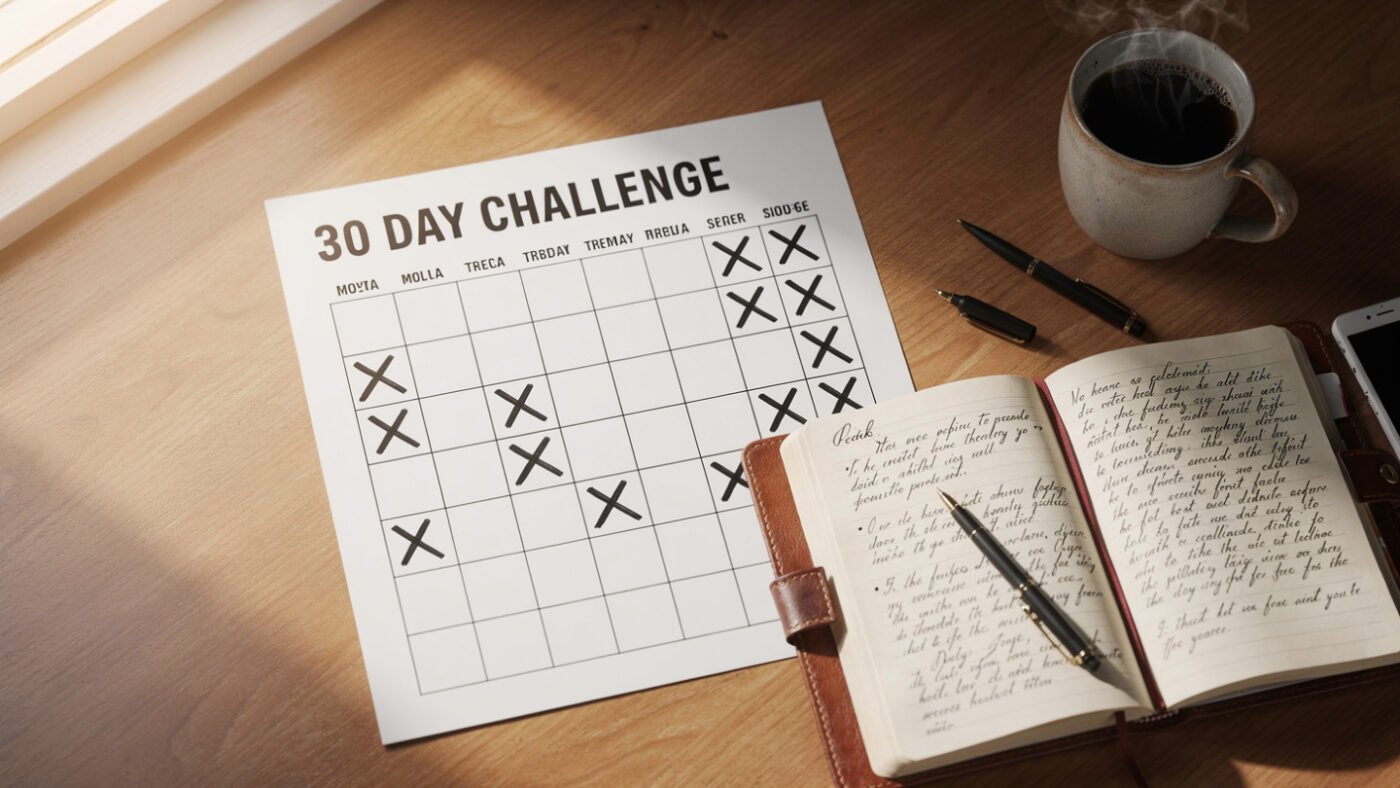
Print a simple 30-day calendar. Mark each completed day with an X. The visual chain of X marks creates a mild but real motivational pressure that digital trackers rarely replicate.
3. Anchor each habit to an existing trigger
“After I make my morning coffee, I write my three priorities.” “After I sit at my desk, I read for 20 minutes.” Habit stacking uses existing behaviors as reliable triggers for new ones.
4. Never miss two days in a row
One missed day is human. Two missed days is the start of a new pattern. That single rule — never miss two consecutive days — has a documented protective effect on long-term habit formation.
5. Write your “why” on day one
Before starting, write one paragraph explaining why this month matters to you. Read it on day 7, day 14, and day 21. The written why is the most powerful recovery tool when motivation fades.
6. Record micro-evidence of change
At the end of each week, write one specific thing that changed — an energy shift, a completed task, a conversation that went differently, a moment of peace. These micro-evidences compound into a powerful body of proof by day 30.
“A 30-day challenge does not change your life by magic. It changes your life by evidence — 30 days of proof that you keep the promises you make to yourself.”

5 Questions People Ask Most About 30-Day Self Improvement Challenges
1. Can 30 days of self improvement really make a lasting difference?
Yes — with an important qualification. Thirty days is enough to establish the early structure of new habits and to produce measurable changes in energy, focus, mood, and confidence. Research confirms that behavioral shifts begin appearing within 21 days of consistent practice. However, habits become truly automatic at an average of 66 days. So the honest answer is: 30 days plants the seed and provides real evidence of growth — but the habits require continuation past day 30 to fully consolidate.
2. What is the most important habit to include in a 30-day self improvement challenge?
Based on the convergence of Tom Corley’s Rich Habits research, neuroscience literature on behavior change, and consistent patterns across high-performer profiles, daily reading combined with morning intentionality is the most impactful pairing for a 30-day challenge. Reading compounds knowledge and reduces stress simultaneously. Morning intentionality — writing one clear priority or intention before reactive demands begin — directs attention and builds agency over the shape of the day.
3. Is a 30-day challenge suitable for people who have never done self-improvement before?
Yes — and it is arguably the ideal starting point for beginners. The finite, structured format removes the overwhelm of open-ended self-improvement. Daily actions are specific and achievable. The challenge provides a narrative — “I am doing a 30-day challenge” — which reduces daily decision fatigue and replaces it with a simple commitment.
4. What should you do after completing a 30-day self improvement challenge?
The post-challenge period is the most critical. Three actions are recommended: first, identify the two or three habits that produced the most visible change and commit to them permanently. Second, design a post-challenge daily structure that includes those habits with specific times and triggers. Third, begin planning the next 30-day challenge — focused on the next area of growth. Month-to-month 30-day challenges, each building on the previous one, are one of the most effective long-term personal development structures available.
5. What are the most common reasons 30-day challenges fail?
Three patterns appear most consistently. First, the daily actions are too large — requiring energy and time that collapses under real-life pressure. Second, the challenge has no accountability structure — no record, no partner, no tracking system. Third, there is no recovery plan for missed days — one skipped day triggers guilt, which triggers avoidance, which ends the challenge. The fix: keep actions small, track visually, and commit to the “never miss two days in a row” rule.

Final Thoughts
A 30-day self improvement challenge is not a shortcut to a better life. It is something more valuable: a structured experiment in self-trust. Every completed day is evidence that you are capable of choosing growth over comfort, action over avoidance, and presence over distraction.
The plan in this guide was designed to be done by real people in real lives — not idealized versions with perfect schedules and unlimited energy. The daily actions are small by design. The weekly reviews are built in by design. The full-challenge review on day 30 is built in by design.
Because the goal is not perfection. The goal is proof.
Do the 30 days. Complete the reviews. Carry the three best habits into month two. Then do it again.
That repetition — month after month of deliberate self-investment — is what lasting change actually looks like.
“You do not need a perfect plan. You need a real plan, followed imperfectly but consistently, for thirty days at a time.”
FAQ
Q: What is a 30-day self improvement challenge?
A 30-day self improvement challenge is a structured, daily-action program designed to build new habits across mindset, health, focus, and relationships over 30 consecutive days — using the psychology of commitment devices and implementation intentions to produce measurable behavioral change.
Q: How do I start a 30-day self improvement challenge?
Start by choosing your challenge structure, writing your “why” on day one, setting up a visual streak tracker, and anchoring each daily action to an existing trigger. Begin with the simplest version of each habit and build complexity only after the first week is established.
Q: What habits should be included in a 30-day self improvement challenge?
The most research-supported habits to include are: morning intention-setting, daily movement, reading for 20–30 minutes, writing three daily priorities, gratitude journaling, one hour of deep focused work, weekly review, and a digital-free period each day.
Q: Can you do a 30-day challenge without previous experience?
Yes. The 30-day format is specifically well-suited to beginners because its structure, specificity, and finite timeframe remove the open-ended overwhelm that causes most self-improvement attempts to fail before they begin.
Q: What happens after a 30-day self improvement challenge ends?
Identify the two or three habits that produced the most visible improvement. Build them permanently into a daily structure with specific times and triggers. Then design the next 30-day challenge focused on your next growth area.