

Self-Improvement
How to Stay Motivated Every Day

Apr
How to Stay Motivated Every Day: Practical Methods That Actually Work
Most people think motivation is something you either have or you do not. That is one of the biggest mistakes in self-improvement. Learning How to Stay Motivated Every Day is actually a skill — one you build through the right habits, the right mindset, and a clear understanding of how your brain works.
Here is the truth: successful people do not stay motivated all the time. Instead, they build systems that keep them moving even when motivation is low. This guide gives you a clear promise — practical, simple steps to improve your drive, your habits, your focus, and your emotional strength every day. No fake inspiration. No empty quotes. Just methods that work.
Motivation gets you started. What keeps you going is something deeper — a routine, a reason, and a small action you choose even on your worst days.
Why does motivation disappear so fast?
Why motivation disappears is a question backed by neuroscience, not just personal experience. According to a 2026 neuroscience breakdown published by Fact of States, motivation loss is driven largely by dopamine — the brain’s anticipation chemical.
Dopamine rises when your brain expects a reward or sees clear progress. However, when rewards feel distant, progress feels invisible, or novelty fades, dopamine activity drops — and so does your drive. That is why you feel unstoppable on Day 1 of a new goal, and then exhausted and flat by Day 14.
Several brain-based factors speed up motivation loss:
-
Delayed rewards: Your brain prefers near rewards over distant ones.
-
Mental fatigue: Cognitive overload makes effort feel too costly.
-
Lack of visible progress: No feedback loop means no dopamine signal.
-
Overstimulation: Constant phone use trains your brain to need fast rewards, making slow, hard work feel unbearable.
Important consideration
Understanding why motivation disappears is the first step toward fixing it. When you stop treating motivation loss as a personal failure and start treating it as a predictable brain pattern, you can design better habits to work around it.
Motivation does not disappear because you are weak. It disappears because your brain is doing exactly what it was designed to do.
What is the difference between motivation and discipline?

Motivation vs discipline is one of the most important distinctions in self-improvement. Motivation is the spark that starts action. Discipline is what keeps you moving after the spark fades.
Mendi’s 2025 analysis on motivation and discipline explains it simply: motivation initiates through desire and purpose, while discipline sustains through consistency, structure, and self-control. One gives you the reason. The other gives you the habit. And the habit is what produces real results.
Research published in the journal Physical Education and Sport Pedagogy found that autonomous motivation — the kind driven by personal values, not external pressure — positively predicts disciplined behavior over time. So when your motivation connects deeply to what you care about, it naturally leads to stronger discipline.
Key point
Do not wait to feel motivated before you act. Instead, act first and let the feeling follow. That is how discipline becomes the foundation and motivation becomes the bonus.
Important consideration
Goal-setting research shows that establishing clear, measurable goals can increase performance by up to 25% because they create direction, accountability, and visible milestones that keep both motivation and discipline reinforced.
Motivation is the spark. Discipline is the fire. You need both — but you can only build one on purpose.
How do you get motivated instantly when you feel stuck?
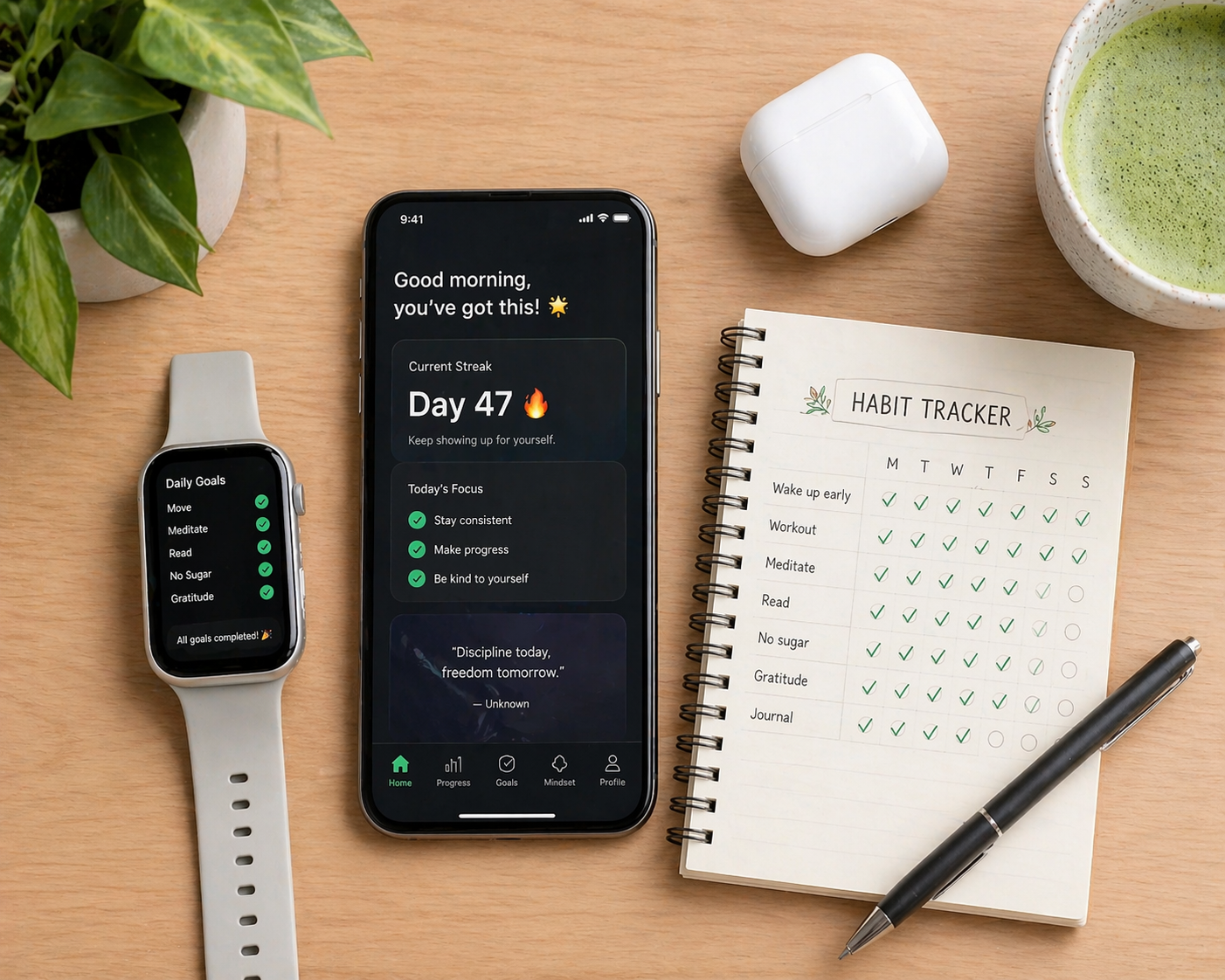
How to get motivated instantly does not require a speech or a YouTube video. It requires one small action that breaks the inertia.
The most reliable technique is what psychologists call activation energy reduction — making the first step so small that your brain cannot argue with it. Starting with only two minutes of action is enough to trigger the brain’s reward system and create forward momentum.
Self-motivation techniques that work
Use these:
-
Name your reason: Ask “Why does this matter today?” and say the answer out loud.
-
Use a 2-minute start: Commit to only two minutes on the task. Most of the time, you keep going.
-
Track one small win: Checking something off activates a small dopamine response and builds forward momentum.
-
Change your physical state: Stand up, drink water, take five deep breaths, or walk for two minutes. Physical movement changes mental state faster than thinking does.
Pro tip
Forbes research confirms that 20 minutes of daily movement raises energy, improves focus, and increases emotional drive throughout the day. So when you feel stuck, move first and think second.
You do not need to feel motivated to start. You need to start in order to feel motivated.
What does a daily motivation routine actually look like?
A Daily motivation routine is not a two-hour morning ritual. It is a short, repeatable structure that protects your energy and keeps you connected to your goals, even on hard days.
The key is that your routine should be consistent enough to reduce daily decisions and strong enough to carry you through low-motivation moments without needing willpower.
A simple daily motivation structure
Use this:
-
Morning (10–15 min): Read your top goal, say one grounded sentence, and set your first three tasks before you open your phone. This is your Morning motivation anchor.
-
Midday (5 min): Check one task off your list. Review your reason why. Drink water and move briefly.
-
Evening (10 min): Write one win from today, no matter how small. Plan the first action for tomorrow.
Real life example: if you are building a new habit — like writing, exercising, or studying — you do not need to feel inspired every day. You need a structure that removes the daily negotiation. When your routine runs on autopilot, motivation becomes less necessary.
Morning motivation
Morning motivation does not come from scrolling inspiring content. It comes from clarity. When you know your priorities before the day begins, you reduce decision fatigue and start from a position of direction, not chaos.
Your routine does not care how you feel. That is exactly why it works.
How do I stay motivated during hard times?
Motivation during hard times is the hardest kind to maintain, and also the most important. Hard periods — burnout, failure, loss, uncertainty — strip away the external rewards that usually keep drive alive.
During hard times, the research points to one core principle: shift from outcome-based motivation to process-based motivation. In other words, instead of staying motivated by a distant result, stay motivated by the next small action you can control right now.
What actually works during hard periods
-
Reduce the goal size: When the big goal feels impossible, work only on the smallest next step.
-
Track progress visually: Human Amplified’s motivation guide explains that seeing growth — even small growth — reminds your brain you are capable and moving forward.
-
Connect to your values: University of Pennsylvania’s Positive Psychology Center confirms that self-awareness and intrinsic values are a strong driver of sustained motivation, especially when external rewards disappear.
-
Use accountability: Telling one trusted person your next commitment raises the cost of quitting and adds external structure when internal drive is low.
Important consideration
Hard times often signal that your current goals need to be adjusted, not abandoned. Pneuma Springs’ 2026 guide notes that even the most successful, driven people regularly lose motivation — and the difference is not how they feel, but how they respond.
In hard times, do not wait for motivation to return. Lower the bar until you can clear it. Then raise it slowly.
How can students stay motivated to study and reach their goals?
Motivation for students fades fast because academic goals are long-term, rewards are delayed, and failure is public. That combination is exactly what the dopamine system dislikes most.
However, there are specific techniques that work well in study contexts. The key is to make progress visible, connect work to personal meaning, and reduce the mental cost of starting.
Self-motivation techniques that work for students
Use these:
-
Set micro-goals: Instead of “study for 3 hours,” use “finish chapter 2 before lunch.” Smaller, specific goals give your brain a clearer signal that progress is happening.
-
Track streaks: A simple calendar where you mark each day you studied creates a visual chain you do not want to break.
-
Study in short blocks: Two 45-minute focused sessions beat one three-hour distracted session. Use the Pomodoro structure or simple time blocks.
-
Connect to purpose: Ask “What will I be able to do because I learned this?” Intrinsic motivation grows stronger when effort connects to personal meaning.
Important consideration
For students especially, comparing yourself to others kills motivation faster than failure does. Your goal is not to be the best in the group. Your goal is to be better than you were last week.
The student who shows up consistently always beats the one who studies intensely once a week.
Motivation vs discipline: which one should you rely on?
The honest answer is that you should build discipline and use motivation as a bonus.
Motivation is emotional. It rises and falls based on mood, energy, environment, and novelty. Discipline is structural. It runs on habits, routines, and systems that do not depend on how you feel. According to Lifewideebook’s motivation and discipline analysis, motivation fluctuates while discipline creates consistent behavior that builds real results.
Side-by-side comparison
Pro tip
Use motivation when it is available to build momentum fast. Then build a system — a clear schedule, a small daily habit, a clear rule — so that when motivation drops, the system keeps you on track.
Motivation is the best employee when it shows up. Discipline is the one that never calls in sick.
Who is this guide for?
This approach to staying motivated works best for:
-
Beginners who start strong but lose consistency after two weeks.
-
Students trying to stay on track with study goals.
-
Professionals dealing with burnout or low drive.
-
Anyone rebuilding habits after a difficult period.
-
People who rely on motivation and keep disappointing themselves.
It helps less if you are in a clinical burnout or depression state. In those cases, professional support is a better first step than productivity strategies.
Common mistakes that kill daily motivation
Avoid these:
-
Relying on motivation to start. Waiting until you feel inspired means waiting indefinitely.
-
Setting goals that are too large. Big goals with no visible progress kill dopamine and drain drive.
-
Skipping rest. Fatigue suppresses the brain’s motivation circuits faster than almost anything else.
-
Consuming too much motivational content. Watching and reading about motivation is not the same as training it. It can actually reduce real action.
-
Ignoring small wins. Not celebrating progress tells your brain the effort is not worth it.
Reflection prompts
Use these at the end of any low-motivation day:
-
What is one reason my goal still matters today?
-
Was today’s drop in motivation about the goal — or about energy, sleep, or stress?
-
What is the smallest action I could have taken instead of nothing?
-
Where did I let motivation run my behavior instead of discipline?
-
What will I set up tonight so tomorrow starts easier?
7-day motivation reset plan
Day 1: Write one main goal and three reasons it matters to you personally. Read them every morning.
Day 2: Build your Daily motivation routine. Keep it under 15 minutes. Focus on clarity, not intensity.
Day 3: Track one win, no matter how small. Start a 7-day streak journal.
Day 4: Use a 2-minute start on the task you have been avoiding.
Day 5: Protect your Morning motivation by keeping your phone away for the first 30 minutes of the day.
Day 6: Connect your goal to a personal value. Ask: “Who do I become by doing this?”
Day 7: Review the week. Ask what helped most and what pattern made things harder. Adjust one thing.
you can also check : How to stay motivated when depressed