

Success
How to Build Self-Trust in 30 Days

Jun
How to Build Self-Trust in 30 Days: A Step-by-Step Path From Doubt to Confidence
Self-trust is built through patterns, not promises alone, and psychologists increasingly describe it as the result of small commitments followed through over time rather than a sudden feeling of certainty. If you want to build self-trust in 30 days, the goal is not to become perfect overnight; it is to prove to yourself, day after day, that your word means something.
What the infographic says
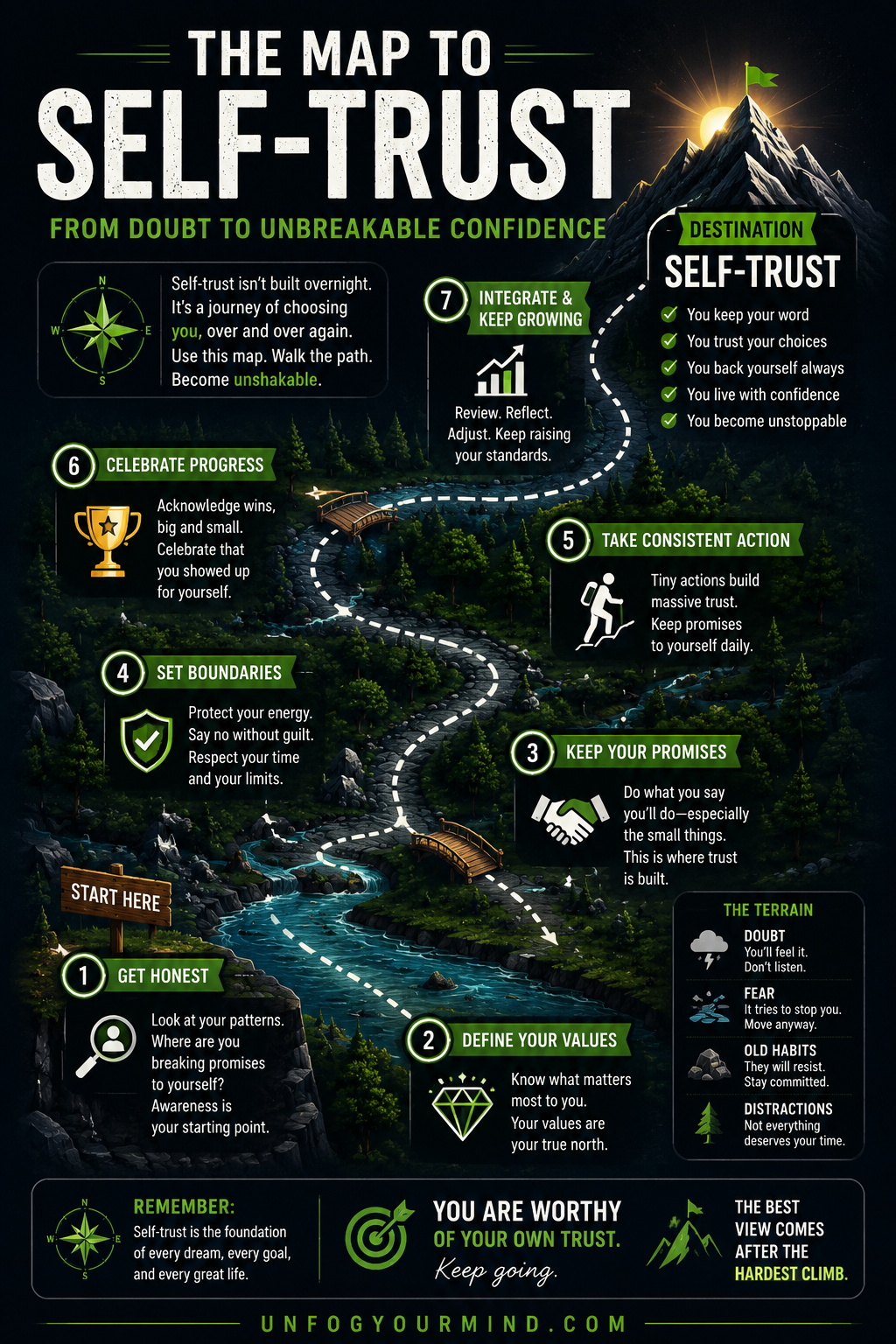
The infographic presents self-trust as a journey from doubt to “unbreakable confidence,” beginning with honesty about your patterns and ending with integration, reflection, and continued growth. It highlights 7 stages: get honest, define your values, keep your promises, set boundaries, take consistent action, celebrate progress, and integrate what you learn.
That framework closely matches current psychology-based advice, which emphasizes specific commitments, decision closure, values-aligned action, and boundaries as key ways to strengthen trust in yourself.

The 7-step framework
1. Get honest
The first step is awareness: notice where you keep abandoning yourself, overcommitting, or breaking promises to yourself. Self-trust starts when you stop avoiding your patterns and name them clearly.
2. Define your values
Values act like an internal compass. When you know what matters most to you, decisions become less reactive and more grounded, which makes it easier to trust your judgment.
3. Keep your promises
Multiple sources point to this as the heart of self-trust: confidence grows when you consistently keep small, realistic promises to yourself. Tiny follow-through matters more than dramatic bursts of motivation.
4. Set boundaries
Boundaries protect your time, energy, and emotional safety. They are not the opposite of trust; they are often what allows trust to grow because they reduce self-abandonment.
5. Take consistent action
Self-trust deepens through repetition. Forbes notes that self-trust shows up as a pattern, and that small habits and closed decisions help create a stronger sense of control.
6. Celebrate progress
Acknowledging wins reinforces the evidence that you are showing up for yourself. This matters because the brain builds trust from proof, not vague intention.
7. Integrate and keep growing
Reflection helps you refine standards without shame. If something did not work, the healthiest response is adjustment, not self-attack.
30-day action plan

Below is a practical 30-day structure built from the infographic’s steps and supported by current self-trust guidance.
Week 1: Awareness and honesty
- Day 1: Write down 5 ways you break promises to yourself.
- Day 2: Track one situation where you ignored your own needs.
- Day 3: Notice where doubt gets louder than evidence.
- Day 4: Journal about one decision you still second-guess.
- Day 5: Identify your most common self-betrayal pattern.
- Day 6: Write a “truth list” about what is draining you.
- Day 7: Review the week and choose one pattern to change first.
This week matters because self-trust begins with noticing your patterns instead of pretending they are not there.
Week 2: Values and promises
- Day 8: List your top 5 personal values.
- Day 9: Narrow them down to 3 core values.
- Day 10: Write one sentence defining what each value means in real life.
- Day 11: Make one tiny daily promise you can realistically keep.
- Day 12: Repeat it again.
- Day 13: Repeat it again and track completion.
- Day 14: Reflect on how follow-through changed your mood.
Research-backed advice suggests self-trust grows faster when commitments are small, specific, and achievable rather than ambitious and vague.
Week 3: Boundaries and action
- Day 15: Identify one area where you need a boundary.
- Day 16: Practice saying no once without overexplaining.
- Day 17: Protect one hour of focused time for yourself.
- Day 18: Decline one obligation that conflicts with your values.
- Day 19: Take one uncomfortable but aligned action.
- Day 20: Repeat your small promise and add one new action.
- Day 21: Review how boundaries affected your stress and clarity.
Healthy boundaries help you feel internally safe, and that sense of safety makes self-trust easier to sustain.
Week 4: Consistency, celebration, and integration
- Day 22: Write down 10 small wins from the month.
- Day 23: Celebrate one win without minimizing it.
- Day 24: Review a recent decision and practice decision closure.
- Day 25: Adjust one habit that was unrealistic.
- Day 26: Recommit to your values-based promise.
- Day 27: Notice evidence that you now trust yourself more.
- Day 28: Write a letter to yourself about how far you’ve come.
- Day 29: Build your next 30-day self-trust promise.
- Day 30: Review the month and define your new standard.
This final phase reflects the idea that trust grows through reflection, adjustment, and repeated proof, not perfection.
Why this works
The reason this approach works is that self-trust is behavioral before it becomes emotional. You do not first feel deeply trusting and then follow through; you follow through repeatedly, and the feeling grows from the evidence.
That is also why boundaries, values, and kept promises matter so much. They reduce internal conflict and teach your nervous system that you are reliable, responsive, and capable of protecting your own well-being.
Frequently Asked Questions
Can you really build self-trust in just 30 days?
Yes – not complete, unshakable trust, but a strong foundation. Thirty days is enough to establish new patterns and gather enough evidence to start believing in your own reliability. The key is consistency, not perfection.
What if I break a promise to myself during the 30 days?
That’s normal. The goal is not to be flawless but to notice, adjust, and recommit. Each time you course-correct, you’re reinforcing the habit of self‑awareness. Don’t let one slip turn into self‑abandonment.
How do I know if I’m making real progress?
Look for small, tangible signs: you feel less anxious about decisions, you catch yourself overcommitting less often, and you actually complete the tiny promises you set. Progress is behavioural before it’s emotional.
Do I need to follow the 30‑day plan exactly?
No – adapt it to your life. The structure is a guide. If a daily task feels too big, shrink it. The principle is to keep showing up, even if it’s in smaller steps than you expected.
What’s the most important step for building self‑trust?
Keeping small, realistic promises to yourself (step 3) is often cited as the core driver. It’s the daily repetition of follow‑through that rewires your internal belief system.