

Self-Improvement
Why Social Media Is Destroying Your Self-Worth
Why Social Media Is Destroying Your Self-Worth — 10 Warning Signs to Recognize Now.
Social media was built to connect us. But for millions of people, it’s quietly doing the opposite — eroding self-worth, fueling comparison, and replacing authentic identity with a curated performance.
If you’ve ever closed an app feeling worse than when you opened it, you’re not imagining things. Research confirms that excessive or maladaptive social media use is directly linked to anxiety, depression, and diminished self-worth — particularly in young adults. Here are the 10 warning signs that social media is destroying your self-worth, and what you can do to reclaim yourself.
The Science Behind Social Media and Self-Worth
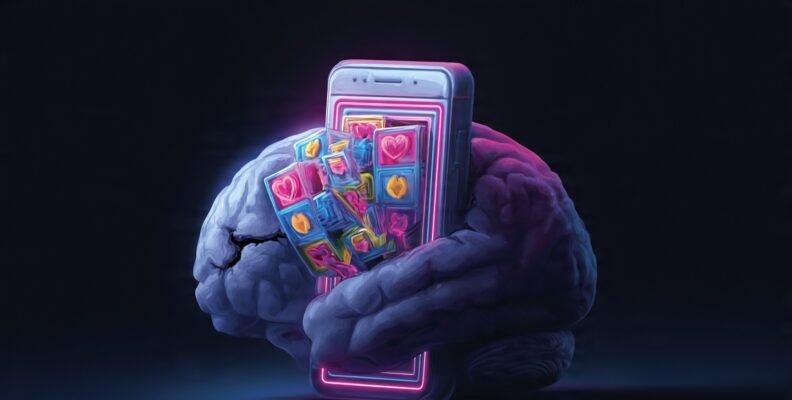
Every time you receive a like, comment, or share, your brain releases dopamine — the same feel-good chemical triggered by food, sex, and even cocaine. Over time, your brain builds tolerance to this reward loop, requiring more and more engagement just to feel neutral. This neurochemical cycle means you’re no longer using social media — social media is using you.
A 2026 peer-reviewed study in the Journal of Media and Communication confirmed that excessive social media use is linked to heightened anxiety, depression, and diminished self-worth, with adolescents and young adults being especially vulnerable. The platforms are not neutral tools — they are algorithmically designed to maximize engagement at the expense of your mental health.
10 Warning Signs Social Media Is Destroying Your Self-Worth
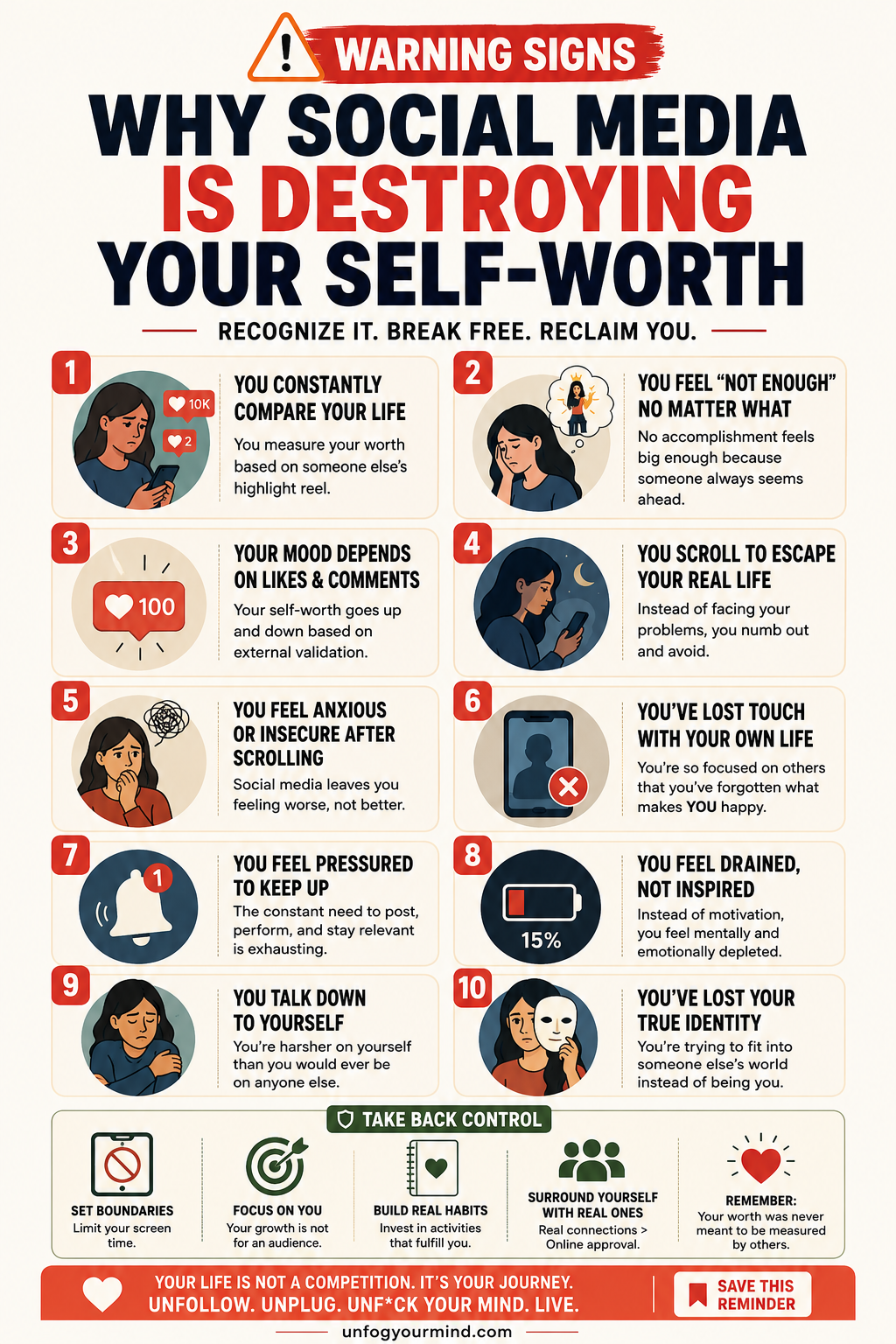
Sign 1: You Constantly Compare Your Life
You measure your value against someone else’s highlight reel. Their vacation photos, body, relationship, and career wins become the invisible ruler you use to measure your own life — and you always fall short. But what you’re comparing yourself to isn’t reality. It’s a carefully filtered, edited, and curated version of someone’s best 1% moments.
Sign 2: You Feel “Not Enough” No Matter What
No accomplishment feels big enough because someone online always seems further ahead. You get a promotion — and immediately see someone else announcing theirs. You finish a project — and someone else just launched a company. This endless upward comparison makes genuine achievement feel worthless, feeding a cycle of chronic inadequacy.
Sign 3: Your Mood Depends on Likes and Comments
When a post performs well, you feel validated. When it doesn’t, you feel invisible. If your emotional state fluctuates with your engagement metrics, your self-worth has been outsourced to an algorithm. Research shows that people who regularly check post performance obsessively experience significant mood crashes when expected engagement doesn’t arrive.
Sign 4: You Scroll to Escape Your Real Life
Instead of facing stress, boredom, or difficult emotions, you reach for your phone. Doom-scrolling becomes a numbing mechanism — not a conscious choice but an automatic behavior triggered by discomfort. UC Davis Health warns that this avoidance pattern actively worsens the underlying anxiety it’s meant to soothe.
Sign 5: You Feel Anxious or Insecure After Scrolling
Pay attention to how you feel after closing an app. If you consistently feel worse — more anxious, less attractive, less accomplished — that’s not a coincidence. That’s your nervous system telling you that what you just consumed was harmful. Psychology Today notes that social media platforms are specifically designed to trigger social comparison, and that comparison directly corrodes confidence.
Sign 6: You’ve Lost Touch With Your Own Life
You’re so consumed by what others are doing that you’ve forgotten what actually makes you happy. Your hobbies, preferences, goals, and opinions have been quietly replaced by a curated identity built for an audience. If you can’t answer “What do I genuinely enjoy?” without referencing what looks good online, this sign applies to you.
Sign 7: You Feel Pressured to Keep Up
The constant need to post, perform, and stay relevant is exhausting. Influencer culture and algorithm-driven content have created a digital arms race where your value feels contingent on your output. The British Psychological Society notes that social media algorithms actively reinforce narrow ideals and pressure users to conform — rewarding performance over authenticity.
Sign 8: You Feel Drained, Not Inspired
Instead of leaving social media feeling motivated or connected, you feel mentally and emotionally depleted. This is a clear signal that your consumption pattern has tipped from healthy to harmful. Inspiration should energize you. If your feed consistently drains your battery — emotionally and literally — it’s time to reassess what you’re consuming and why.
Sign 9: You Talk Down to Yourself
Social media has made you harsher on yourself than you would ever be on anyone else. Constant exposure to polished, filtered images creates unrealistic standards that fuel self-criticism about your body, lifestyle, achievements, and relationships. A cross-sectional study found that 64.7% of people with low self-esteem reported negative social media effects — compared to 32.2% of the general population.
Sign 10: You’ve Lost Your True Identity
You’ve started trying to fit into someone else’s world instead of being yourself. Your opinions, aesthetics, and even your sense of humor have been replaced by whatever gets the most engagement. When you no longer know who you are offline, social media hasn’t just hurt your self-worth — it has replaced your identity.
The 10 Warning Signs at a Glance
| # | Warning Sign | What It Looks Like |
|---|---|---|
| 1 | Constant comparison | Measuring worth by others’ highlight reels |
| 2 | Never feeling enough | No achievement satisfies because someone’s “ahead” |
| 3 | Mood tied to metrics | Self-esteem rises/falls with likes and comments |
| 4 | Scrolling to escape | Using the feed to numb stress or avoid problems |
| 5 | Anxiety after scrolling | Feeling worse after every session |
| 6 | Lost sense of self | Forgetting what genuinely makes you happy |
| 7 | Pressure to keep up | Exhaustion from performing for an audience |
| 8 | Feeling drained | Emotional depletion instead of inspiration |
| 9 | Harsh self-talk | Criticizing yourself through others’ filtered lens |
| 10 | Lost identity | Living for online approval instead of your own truth |
How to Take Back Control: 5 Steps
If several of these signs resonate, the goal isn’t to delete all social media forever — it’s to reclaim a conscious relationship with it. Here’s how:
- Set boundaries — Use built-in screen time limits on your phone. Designate social-media-free hours each day, especially mornings and the hour before sleep.
- Focus on you — Your growth is not for an audience. Pursue goals, hobbies, and milestones that you would never post about.
- Build real habits — Invest your time in offline activities that fulfill you: exercise, reading, creating, cooking, spending time in nature.
- Surround yourself with real people — Real connections provide the genuine validation and belonging that no algorithm can replicate.
- Curate your feed ruthlessly — Unfollow any account that consistently triggers comparison, inadequacy, or anxiety.
Frequently Asked Questions
Can social media actually lower your self-esteem?
Yes — multiple peer-reviewed studies confirm a direct link between heavy social media use and lower self-esteem, particularly when usage centers on passive scrolling and social comparison. A 2026 research review covering studies from 2020–2026 found consistent evidence that excessive social media engagement is associated with heightened anxiety, depression, and diminished self-worth.
Why do I always feel worse after using Instagram or TikTok?
These platforms are algorithmically designed to surface content that triggers emotional responses — including envy, insecurity, and FOMO. The dopamine cycle they create means you keep returning despite feeling worse each time. UC Davis Health researchers describe this loop as directly worsening the anxiety it appears to temporarily soothe.
How much social media use is too much?
There is no universal “safe” number, but research points to passive scrolling — consuming without creating or connecting — as the most harmful pattern. Setting intentional daily limits (under 30 minutes for recreational use) and replacing screen time with real-world activities significantly improves self-esteem and life satisfaction.