

Productivity
how to create a personal financial plan

Jun
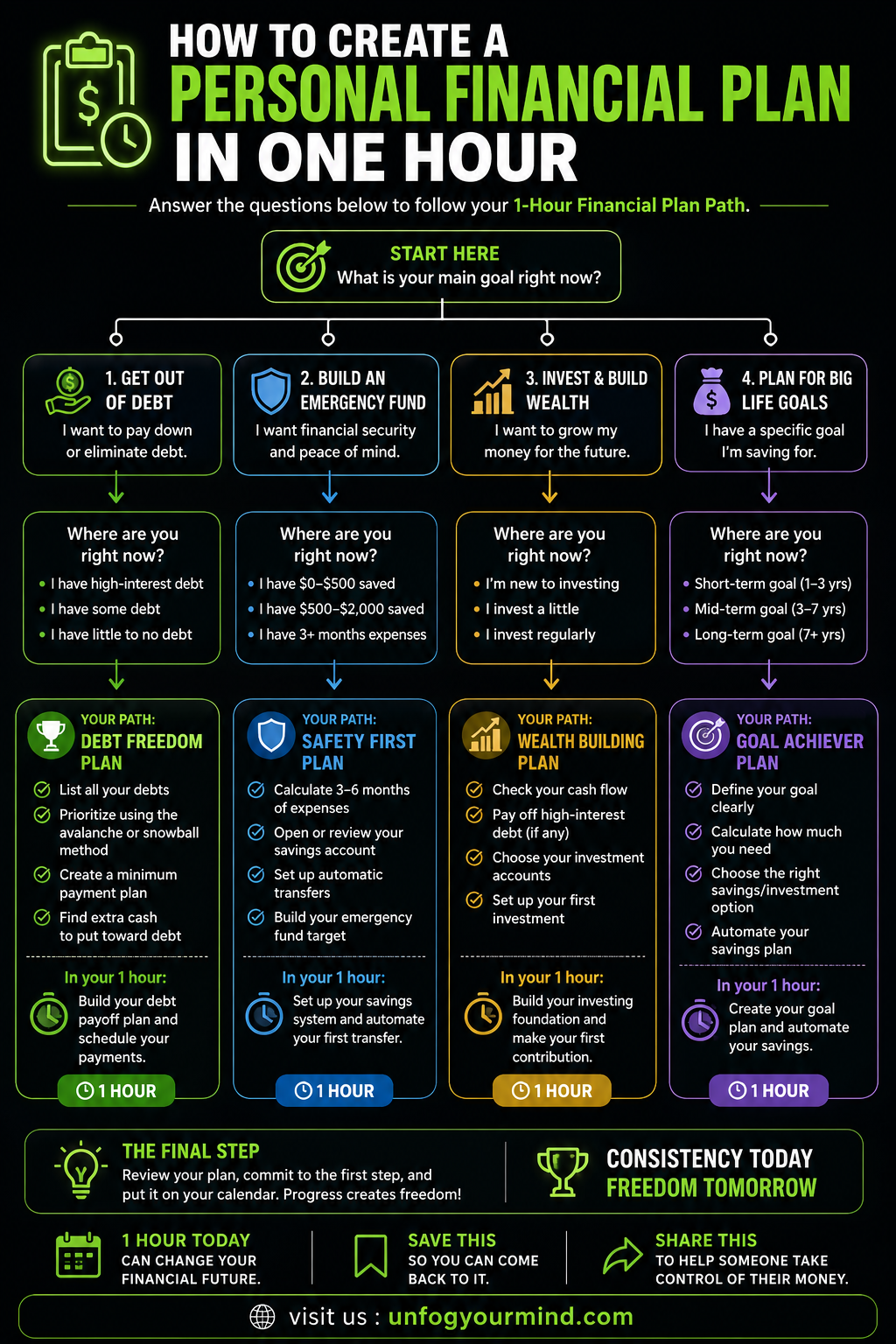
How to Create a Personal Financial Plan in One Hour
Most people avoid building a financial plan because they believe it requires a professional, a spreadsheet, or hours of complex calculations. None of that is true.
A basic, functional personal financial plan can be built in one focused hour — and it is the single most impactful financial move most people will ever make. This guide walks you through all four financial planning paths: getting out of debt, building an emergency fund, investing and growing wealth, and planning for big life goals. Find your path, follow the steps, and use your one hour today.
Why Most People Never Build a Financial Plan — And Why That’s the Real Problem

The California Department of Financial Protection and Innovation confirmed in its 2026 financial planning guidance that one of the leading causes of financial stress is simply not knowing what you own, what you owe, and where your money is going each month. Without a written plan, money is managed reactively — responding to bills and impulses rather than directing resources toward intentional goals.
The good news is that you do not need to solve your entire financial life in one sitting. You need to identify your current main goal, build the simplest possible plan around it, and take the first action today. Progress creates momentum — and momentum creates freedom.
Identify Your Main Financial Goal Right Now
Before building any plan, the most important question is: what is your primary financial goal at this moment?
The infographic — and aligned financial planning guidance — identifies four distinct starting points:
- Goal 1: Get out of debt
- Goal 2: Build an emergency fund
- Goal 3: Invest and build wealth
- Goal 4: Plan for a specific big life goal
Most financial experts recommend addressing these in roughly this order for most people — though individual circumstances always vary. Find the goal that describes your current situation and follow its path below.
Path 1: Get Out of Debt — The Debt Freedom Plan
Who this is for: Anyone carrying high-interest debt, student loans, credit card balances, or multiple outstanding obligations.
Where are you right now?
- You have high-interest debt (credit cards, personal loans)
- You have some debt but manageable balances
- You have little to no debt but want to eliminate what remains
Your Debt Freedom Plan — 4 Steps
1. List all your debts. Write down every debt: balance, interest rate, minimum payment, and lender. You cannot tackle what you have not named.
2. Choose your repayment method. The two most evidence-backed approaches are:
- Debt Avalanche: Pay minimums on all debts, then direct all extra cash to the highest-interest debt first. Mathematically optimal — saves the most money.
- Debt Snowball: Pay minimums on all debts, then direct all extra cash to the smallest balance first. Psychologically powerful — builds momentum through quick wins.
3. Create a minimum payment plan. Automate every minimum payment so you never miss one. Late fees and credit score damage undo progress fast.
4. Find extra cash to put toward debt. Review your monthly spending for anything cuttable — unused subscriptions, dining out, impulse purchases. Even $50–$100 extra per month dramatically accelerates debt payoff.
In your 1 hour today: List all debts in a spreadsheet, choose avalanche or snowball, calculate your first extra payment, and schedule it.
Path 2: Build an Emergency Fund — The Safety First Plan
Who this is for: Anyone without 3–6 months of expenses saved, who currently has $0–$2,000 in liquid savings.
Where are you right now?
- You have $0–$500 saved
- You have $500–$2,000 saved
- You have some savings but have not reached 3 months of expenses
Your Safety First Plan — 4 Steps
1. Calculate your 3–6 month expense target. Add up your essential monthly expenses: rent/mortgage, groceries, utilities, transport, and minimum debt payments. Multiply by 3 for a starter target; multiply by 6 for full security.
2. Open or review your dedicated savings account. Keep your emergency fund in a separate, high-yield savings account — not your everyday checking account. Separation creates both accessibility and a psychological barrier against casual spending.
3. Set up automatic transfers. Choose a specific amount to transfer automatically on payday — even $50 per paycheck builds the fund over time. Automation removes the decision from the equation entirely.
4. Build toward your emergency fund target. Track progress visually. Set a clear dollar target and watch it fill. Emergency fund completion is one of the most measurable early financial wins available.
In your 1 hour today: Calculate your 3-month expense target, open a high-yield savings account if you do not have one, and set up your first automatic transfer.
Path 3: Invest and Build Wealth — The Wealth Building Plan
Who this is for: Anyone who has their emergency fund established and wants to grow their money for the future.
Where are you right now?
- You are new to investing
- You invest occasionally but inconsistently
- You invest regularly but want to optimize your approach
Your Wealth Building Plan — 4 Steps
1. Check your cash flow. Before investing, confirm that your monthly income consistently exceeds your essential expenses and that you are not funding investments with money you will need in 30 days.
2. Pay off any high-interest debt first. Any debt charging more than 7–8% interest is effectively a guaranteed negative investment. Paying that off before investing produces a risk-free return equivalent to the interest rate.
3. Choose your investment accounts. For most people, the priority order is:
- Employer-matched retirement account (401k, pension) — use the full employer match first; it is a 50–100% instant return
- Individual retirement account (IRA, Roth IRA)
- Taxable brokerage account for additional investing
4. Set up your first investment contribution and automate it. Start with what you can — even $25 per month invested consistently for decades produces meaningful wealth through compounding. The key is to begin.
In your 1 hour today: Open or review your investment account, choose an automated monthly contribution amount, and schedule your first contribution.
Path 4: Plan for Big Life Goals — The Goal Achiever Plan
Who this is for: Anyone saving toward a specific future milestone — a home purchase, a business, education, travel, or any goal with a defined cost and timeline.
Where are you right now?
- You have a short-term goal (1–3 years)
- You have a mid-term goal (3–7 years)
- You have a long-term goal (7+ years)
Your Goal Achiever Plan — 4 Steps
1. Define your goal clearly. Vague goals produce vague results. Write down the specific goal, the exact amount required, and the target date. “Save for a house” becomes “$40,000 for a down payment by January 2029.”
2. Calculate how much you need per month. Divide your total target by the number of months until your deadline. That is your required monthly savings amount.
3. Choose the right savings or investment vehicle.
- 1–3 year goals: High-yield savings account or money market fund (low risk, accessible)
- 3–7 year goals: Conservative investment portfolio or balanced fund
- 7+ year goals: Growth-oriented investment account where compounding has time to work
4. Automate your savings plan. Set up a standing automatic transfer to your goal-specific account on every payday. Name the account after your goal in your banking app — this simple psychological trick increases follow-through.
In your 1 hour today: Write your goal, calculate your monthly savings target, open a dedicated account, and automate your first transfer.
All Four Financial Paths at a Glance
| Path | Best For | Core Strategy | 1-Hour Action |
|---|---|---|---|
| Debt Freedom Plan | Anyone with debt | Avalanche or snowball method | List debts, choose method, schedule first extra payment |
| Safety First Plan | Anyone under 3 months of savings | Automate emergency fund contributions | Calculate target, open account, set auto-transfer |
| Wealth Building Plan | Emergency fund complete | Invest consistently, automate contributions | Open/review account, automate monthly investment |
| Goal Achiever Plan | Saving for a specific milestone | Define goal, calculate monthly amount, automate | Write goal, calculate target, open dedicated account |
The Final Step: Review, Commit, and Schedule

Building the plan is step one. Committing to the first action is step two. The final piece is making it real:
- Review your plan once to confirm it is realistic and specific
- Commit to the first step by completing it today — not tomorrow, not next week
- Put a monthly review on your calendar — 15 minutes once per month to track progress and adjust as your situation changes
Progress creates freedom. Consistency today delivers freedom tomorrow.
Frequently Asked Questions
How do I create a simple personal financial plan?
Start by identifying your primary financial goal right now: eliminating debt, building an emergency fund, investing for wealth, or saving for a specific life goal. Then follow the corresponding four-step path for that goal, automate the first action, and review monthly. The California DFPI’s 2026 financial plan framework recommends starting with evaluating your current income, expenses, and debt before setting goals and building a budget around them.
Should I build an emergency fund or pay off debt first?
Most financial planning guidance recommends a hybrid approach: build a small starter emergency fund of $1,000–$2,000 first, then direct all extra money toward high-interest debt aggressively, then return to building a full 3–6 month emergency fund once the most expensive debt is cleared. This order balances protection against new emergencies while minimizing the interest cost of outstanding debt.
How much should I have in an emergency fund?
The standard recommendation across most certified financial planners is 3–6 months of essential living expenses. Essential expenses include rent or mortgage, groceries, utilities, transportation, and minimum debt payments — not discretionary spending. Start with a $1,000–$2,000 target to build the habit, then expand to the full 3–6 month figure over time.
When should I start investing?
As soon as you have a starter emergency fund and have addressed any high-interest debt. Even small, consistent contributions started early produce dramatically better outcomes than larger contributions started later, due to the compound effect. A 2026 personal finance guide confirmed that starting early and automating contributions is more important than the size of the initial investment.
What is the best way to track my financial progress monthly?
Schedule a 15‑minute monthly review. Check your debt balances, savings account totals, and investment account values. Compare them against your targets. If you’re off track, adjust your automated transfers slightly — don’t quit. Visual tracking (like a simple spreadsheet or a habit tracker) keeps motivation high.