

Success
Costly Mistakes That Keep You Broke

Jun
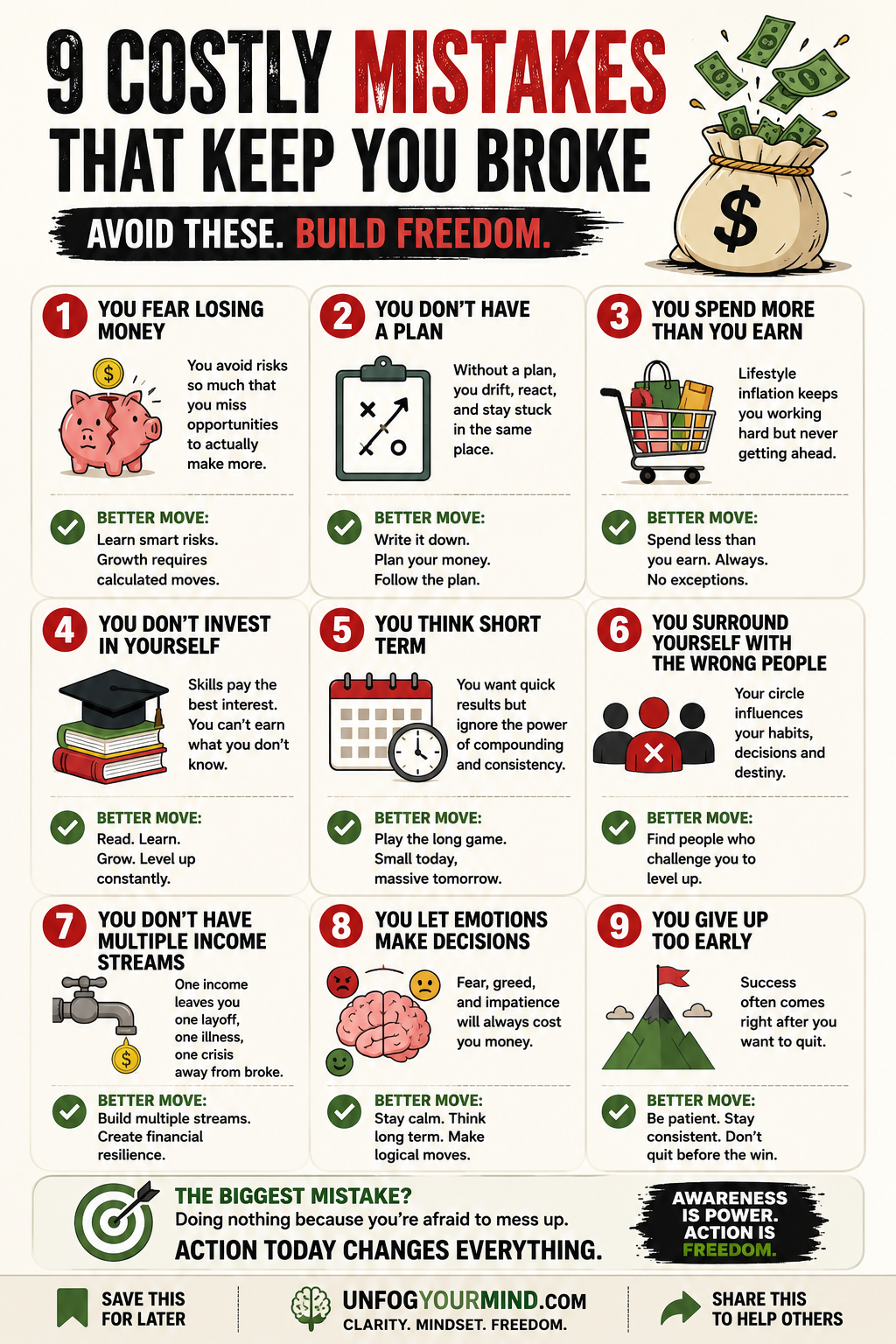
9 Costly Mistakes That Keep You Broke — And the Better Moves That Build Freedom
Most people are not broke because they do not earn enough. They are broke because they keep repeating the same nine financial mistakes — unknowingly, consistently, and expensively.
A 2026 personal finance analysis found that lifestyle inflation, emotional spending, and lack of a financial plan are the most commonly cited causes of financial stagnation across all income levels — including high earners. The good news: every mistake on this list is fixable. Here is what they are, why they happen, and exactly what to do instead.
Mistake 1: You Fear Losing Money
Fear-based financial decision-making is one of the quietest wealth killers in existence. When you are so afraid of losing money that you avoid all risk, you also avoid every opportunity to grow it.
This is rooted in loss aversion — the psychological tendency to feel the pain of a loss roughly twice as strongly as the pleasure of an equal gain. Applied to money, it produces paralysis: savings accounts instead of investments, avoidance instead of education, and inaction instead of calculated progress.
The truth: Growth always requires some level of risk. The goal is not to eliminate risk but to understand it, manage it, and take calculated, informed moves rather than emotional ones.
Better move: Learn smart risks. Study investing basics, financial history, and asset classes. The more you understand, the less scary intelligent risk-taking becomes.
Mistake 2: You Don’t Have a Financial Plan
Without a plan, your money has no direction. Most people who feel perpetually broke are not spending dramatically more than they earn — they are simply drifting, reacting to expenses as they arrive, and wondering why nothing ever accumulates.
Research from Investopedia and multiple 2026 personal finance sources confirms that a clear financial plan — with defined income, spending categories, savings targets, and investment goals — consistently separates people who build wealth from those who stay stuck at zero.
Better move: Write it down. Plan your money before you spend it. Give every dollar a job: essential expenses, savings, investments, discretionary spending. A written plan turns abstract goals into specific actions.
Mistake 3: You Spend More Than You Earn
Lifestyle inflation is the silent destroyer of financial progress. It is the pattern where every raise, bonus, or income increase gets immediately absorbed by a higher standard of living — a nicer car, a bigger apartment, more eating out — leaving your net worth unchanged regardless of how much your income grows.
A 2025 personal finance analysis found that most people increase spending as fast as their income rises, leaving them financially stagnant even at six-figure salaries. The problem is not earning too little; it is that spending grows just as fast as income, leaving nothing left to build with.
Better move: Spend less than you earn. Always. No exceptions. When your income increases, keep your lifestyle the same for at least 6 months and direct the difference toward savings and investments.
Mistake 4: You Don’t Invest in Yourself
Skills are the highest-paying long-term investment available to any person. You cannot earn what you do not know how to create, and you cannot create what you have never learned. Not investing in your skills, knowledge, and mindset is one of the most expensive choices you can make — and one of the most common.
Every year you remain at the same skill level is a year of compounding you lose on your earning potential. People who read, learn, and grow consistently create expanding income opportunities; those who stay static tend to find their value in the marketplace slowly eroding.
Better move: Read. Learn. Grow. Set aside time and budget for deliberate skill-building — books, courses, mentors, and new capabilities that increase what you can offer and earn.
Mistake 5: You Think Short Term
Wealth is built in years and decades, not days and weeks. One of the most common financial mistakes is obsessing over quick wins — get-rich schemes, short-term trades, fast results — while completely ignoring the single most powerful force in finance: compounding.
Compounding requires consistency over time. A person who invests $300 per month for 30 years at an average annual return of 8% will accumulate over $440,000 — not because of one large win, but because of small, consistent action repeated long enough for compounding to work.
Better move: Play the long game. Prioritize assets and habits that build over time. Every small investment made consistently today produces massive results tomorrow.
Mistake 6: You Surround Yourself With the Wrong People
Your financial habits are profoundly shaped by the people you spend the most time with. If your social circle normalizes overspending, discourages investing, and reinforces keeping up appearances at the expense of financial security, those norms quietly become your defaults.
This is not about judging the people in your life — it is about recognizing that behavior is contagious. Research on financial habits consistently shows that proximity to people who prioritize wealth-building, financial literacy, and long-term thinking dramatically increases the likelihood that you adopt the same behaviors.
Better move: Actively seek people who challenge you to grow, who talk openly about building wealth, and who make better financial decisions than you currently do. Proximity is one of the most powerful financial tools available.
Mistake 7: You Don’t Have Multiple Income Streams
A single income is a single point of failure. One unexpected layoff, one health crisis, one economic shift — and everything built on that single source of income becomes immediately fragile. The wealthy do not rely on one paycheck; they build multiple streams that continue generating income regardless of what any single source does.
Better move: Begin building a second income stream — a side business, freelance skill, dividend investments, digital products, or any value-creation vehicle that earns independently of your primary job. Start small. Build it consistently. Your financial resilience depends on it.
Mistake 8: You Let Emotions Make Your Decisions
Fear, greed, and impatience are the three most expensive emotions in personal finance. Fear stops you from investing when markets dip. Greed pushes you into speculative shortcuts. Impatience makes you sell long-term investments during short-term volatility.
Emotional financial decision-making is documented as one of the leading causes of poor investment outcomes, unnecessary debt accumulation, and impulsive spending. The solution is not to eliminate emotions — it is to build a plan strong enough that emotions do not get the deciding vote.
Better move: Stay calm. Think long term. Build a written financial plan so that when emotions spike, your decision-making framework stays intact. Automate investments where possible so human emotion has fewer opportunities to interfere.
Mistake 9: You Give Up Too Early
The final and perhaps most consequential mistake is quitting too soon. Most significant financial progress happens after the point where most people stop. Compound growth is not linear — it starts slowly and accelerates dramatically in the later stages. The people who build real wealth are almost always those who simply did not quit before the exponential phase began.
Better move: Be patient. Stay consistent. Commit to a minimum of 12–24 months before evaluating whether a financial strategy is working. Most worthwhile financial journeys look like they are failing before they succeed.
The 9 Mistakes — Summary Table
| # | Mistake | Why It Keeps You Broke | Better Move |
|---|---|---|---|
| 1 | Fear of losing money | Avoids all risk, misses growth | Learn smart, calculated risk-taking |
| 2 | No financial plan | Drifts, reacts, stays stuck | Write it down, plan before spending |
| 3 | Spending more than you earn | Lifestyle inflation eats every raise | Spend less than you earn, always |
| 4 | Not investing in yourself | Skills stagnate, earning potential caps | Read, learn, grow constantly |
| 5 | Short-term thinking | Misses the power of compounding | Play the long game consistently |
| 6 | Wrong circle | Peer norms become your defaults | Find people who challenge your growth |
| 7 | Single income stream | One crisis = financial collapse | Build multiple income streams |
| 8 | Emotional decisions | Fear, greed, impatience cost you money | Plan-driven, calm, long-term thinking |
| 9 | Giving up too early | Quits before compound growth kicks in | Patient, consistent, never quit before the win |
The Biggest Mistake of All: Doing Nothing
Every mistake above has a fix. But the one mistake with no fix is paralysis — doing nothing because you are afraid to mess up.
Action today — even imperfect, small, uncertain action — changes your financial trajectory. Awareness alone does not build wealth. It is the first step, but only action creates the momentum that compounds into freedom.
Frequently Asked Questions
Why do people stay broke even when they earn good money?
The most common cause is lifestyle inflation — spending increases to match income increases, leaving no surplus to build with. Other major contributors include lack of a financial plan, emotional spending, relying on a single income source, and avoiding investing due to fear. Research across 2025–2026 personal finance sources consistently identifies these behavioral patterns as the real cause of financial stagnation, regardless of income level.
What is the fastest way to stop being broke?
The fastest moves are: write a budget and actually follow it, stop lifestyle inflation immediately when income rises, begin building a side income source, and automate even a small investment each month before spending. None of these require a large income to start — they require consistency and a decision to stop drifting.
How important are multiple income streams?
Extremely important. Multiple income streams are not just a wealth-building strategy — they are a risk management strategy. One income leaves you one crisis away from financial collapse. Even a modest second income stream — a freelance skill, a small side business, dividend income — creates resilience that a single paycheck simply cannot provide.
Does giving up too early actually affect wealth?
Yes, and this is one of the most under-discussed financial patterns. Compound growth is not linear — the bulk of returns accumulate in the later stages of long-term investment. People who exit early forfeit the most valuable phase. Studies on investor behavior consistently show that ordinary people who simply stayed invested and did not quit outperformed most active traders over long periods.
What is the single most important habit to stop being broke?
Tracking every dollar you spend. You cannot fix what you do not measure. When you track your spending for 30 days, you immediately see where your money is actually going — and that awareness alone usually cuts impulsive spending by 15–20% without any extra effort. Combine that with an automated savings transfer on payday, and you have the foundation for lasting change.