

Self-Improvement
Stop Settling for Less Than You Deserve

Jun
Stop Settling for Less Than You Deserve: A Proven Flowchart to Break the Pattern
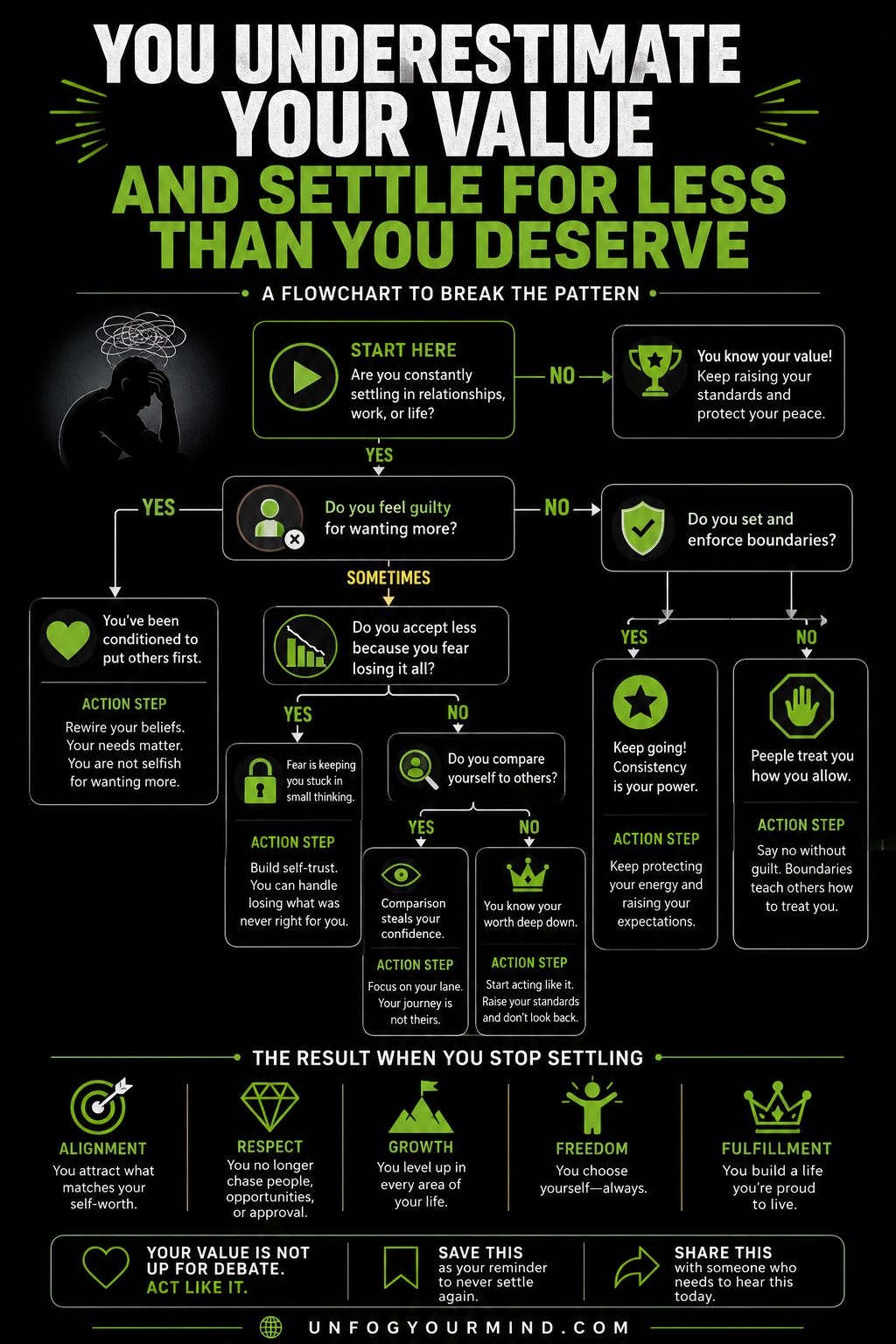
Do you constantly find yourself accepting less than you deserve — in your relationships, your career, or your daily life? You’re not broken. You’ve been conditioned. And that conditioning can be reversed.
This guide walks you through a powerful decision-making framework to help you identify why you settle, recognize the emotional patterns keeping you stuck, and take precise, actionable steps toward a life aligned with your true worth.
Why You Keep Settling (And Why It’s Not Your Fault)

Most people who settle aren’t weak — they’re operating from beliefs that were installed early in life. Research into self-esteem and settling behavior shows that people often accept less because their internal value system was shaped by experiences of guilt, fear, and the need to put others first.
According to Psychology Today, many people who underestimate their worth are caught in a cycle of “chasing approval” rather than recognizing their inherent value. The first step to breaking free is simply recognizing that you are settling — which is exactly where our flowchart begins.
Step 1: Are You Constantly Settling?
Ask yourself honestly: Am I accepting less than I want or deserve in relationships, at work, or in daily life?
If the answer is no — great. Your job is to keep raising your standards and protect your peace. But if the answer is yes, you’ve already made a critical move: awareness.
Most people skip this step entirely. They normalize settling until it becomes their baseline. Naming the pattern is the beginning of ending it.
Step 2: Do You Feel Guilty for Wanting More?
This is where the path splits — and where most people get stuck.
If Yes: You’ve Been Conditioned to Put Others First
Feeling guilty for wanting more is one of the clearest signs of conditioned self-sacrifice. You were taught — whether by family, culture, or past relationships — that your needs come second.
Action Step: Rewire your beliefs. Your needs matter. Wanting more does not make you selfish — it makes you self-aware.
If No: Do You Set and Enforce Boundaries?
If guilt isn’t the issue but you’re still settling, the culprit is often a lack of enforced boundaries. Knowing your worth intellectually is very different from protecting it behaviorally.
- If YES — Keep going. Consistency is your power. Keep protecting your energy and raising your expectations.
- If NO — People treat you how you allow them to.
Action Step: Say no without guilt. Boundaries don’t push people away — they teach others how to treat you.
Step 3: Do You Accept Less Because You Fear Losing It All?
Sometimes we don’t settle out of guilt — we settle out of fear. Fear that if we ask for more, we’ll lose the little we have.
If Yes: Fear Is Keeping You in Small Thinking
Fear of loss is a powerful anchor. It convinces you that staying in an unfulfilling situation is safer than risking change. But here’s the reframe: you cannot lose what was never truly right for you.
Action Step: Build self-trust. Practice making small decisions that honor your needs. Each act of self-trust compounds over time into unshakeable confidence.
If No: Do You Compare Yourself to Others?
If fear isn’t holding you back, the next checkpoint is the comparison trap.
- If YES — Comparison is stealing your confidence. When you measure your journey against someone else’s highlight reel, you’ll always feel behind.
- Action Step: Focus on your lane. Your journey is not theirs. Progress measured against your own past is the only metric that matters.
- If NO — You already know your worth deep down.
- Action Step: Start acting like it. Raise your standards and don’t look back.
The 5 Results When You Stop Settling

Breaking the settling pattern isn’t just about saying no more often. It rewires your entire life. Here’s what changes:
| Result | What It Means |
|---|---|
| Alignment | You attract people, jobs, and experiences that match your actual self-worth |
| Respect | You stop chasing people, opportunities, or approval — they come to you |
| Growth | You level up in every area of your life simultaneously |
| Freedom | You choose yourself — always — without second-guessing |
| Fulfillment | You build a life you’re genuinely proud to live |
The Core Mindset Shift: Your Value Is Not Up for Debate
Everything in this flowchart leads to one fundamental truth: your value is non-negotiable.
You don’t earn worth by being agreeable, by shrinking yourself, or by proving your usefulness to others. Worth is not a reward for good behavior — it’s a baseline you were born with.
The moment you stop treating your value as something that needs to be justified to others is the moment your life starts to align with what you actually deserve.
Action Plan Summary: How to Stop Settling Starting Today
- Audit your life — Identify one area (work, relationships, or habits) where you are currently accepting less than you want
- Name the root cause — Is it guilt? Fear of loss? Comparison? Use the flowchart above to diagnose honestly
- Take one boundary action this week — Say no to one thing that doesn’t serve you, without apologizing
- Build self-trust daily — Make and keep one small promise to yourself every day
- Stop comparing your path — Unfollow accounts, avoid conversations, and remove inputs that trigger comparison
- Raise your standard explicitly — Write down what you actually want in one area of life and refuse to accept less
Frequently Asked Questions
Why do I keep settling even when I know I deserve better?
Knowing your worth intellectually and living it are two different skills. Settling is often a deeply conditioned behavior rooted in fear of abandonment, fear of conflict, or early experiences where your needs were dismissed. Therapy, journaling, and consistent boundary-setting can bridge the gap between what you know and how you act.
Is it selfish to want more?
No. Wanting more — more respect, better opportunities, deeper connections — is not selfishness. It is self-awareness in action. Selfishness involves taking from others. Wanting more for yourself simply means you’ve recognized your own value.
How do I stop comparing myself to others?
Start by measuring your growth against your own past, not someone else’s present. Limit your social media consumption, focus on building your own metrics of success, and remind yourself regularly: someone else thriving doesn’t diminish your potential.
You Can Also Read : How to Stay Motivated every Day