

Mindset
The 5 Levels of Self-Mastery

Jun
The 5 Levels of Self-Mastery: Build Discipline, Mindset & Legacy from the Inside Out.
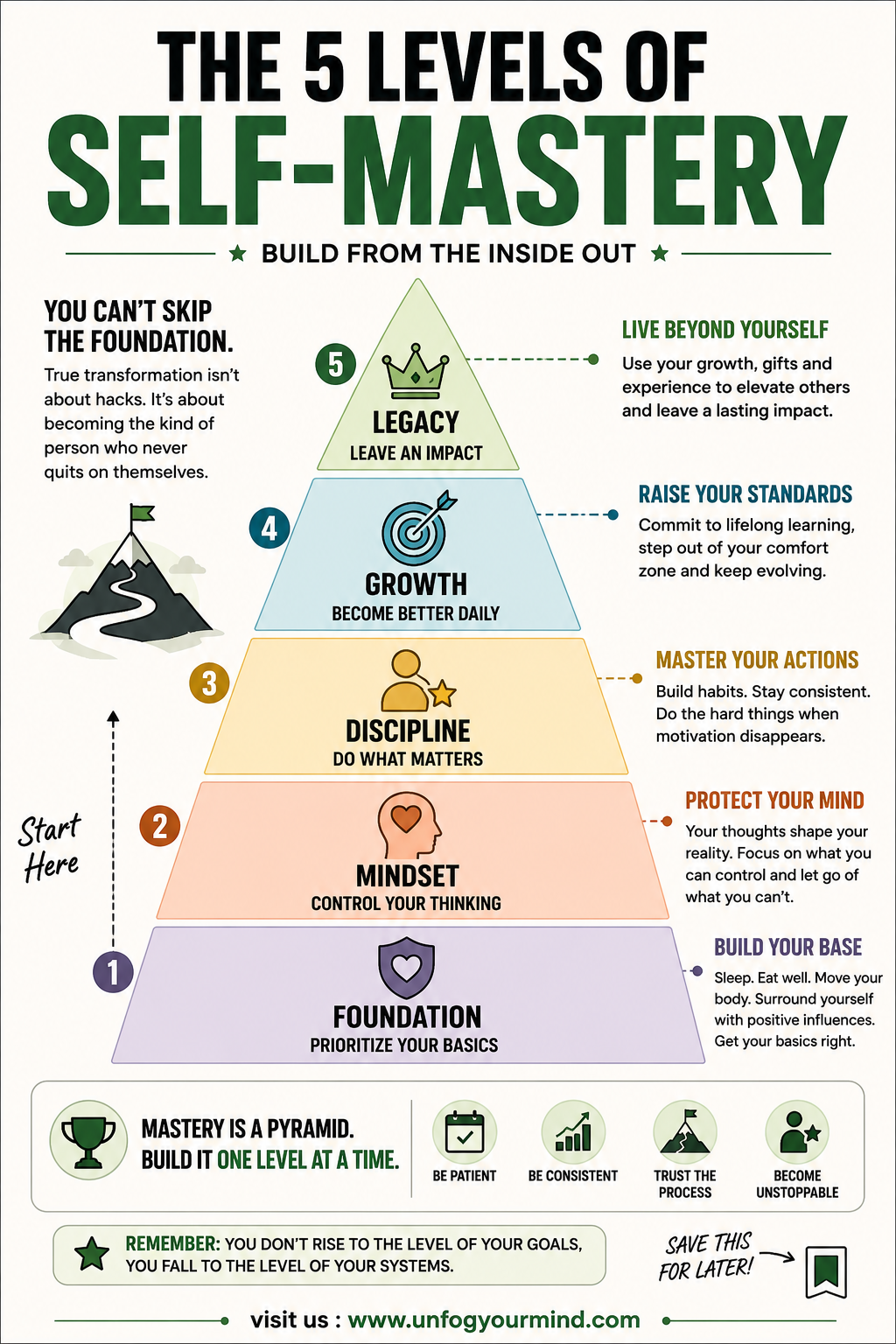
Most people chase success the wrong way. They jump straight to setting big goals without fixing the cracks in their foundation. But here’s the truth that high performers know: you don’t rise to the level of your goals — you fall to the level of your systems.
Self-mastery isn’t a destination. It’s a pyramid — and you have to build it one level at a time.
In this guide, we break down the 5 levels of self-mastery, explain why each one matters, and give you actionable steps to climb from where you are right now to the life you actually want.
What Is Self-Mastery?
Self-mastery is the ongoing process of taking full control over your thoughts, emotions, habits, and actions to align them with your deepest values and long-term vision. It’s not about being perfect — it’s about being consistent.
According to the self-mastery pyramid framework, personal growth is a layered journey where each level builds upon the one below it. You cannot skip the foundation, no matter how motivated or talented you are.
Why the Pyramid Model Works
The pyramid structure is intentional. Just like a building needs a solid base before you can add floors, your personal development requires foundational stability before you can achieve discipline, growth, or legacy.
This model mirrors research in personal development, which consistently shows that sustainable transformation comes from systems, not shortcuts. Each level strengthens the next, creating compounding momentum over time.
Level 1: Foundation — Prioritize Your Basics
Core Principle: Build Your Base
Everything begins here. The foundation of self-mastery is your physical and environmental health — and most people skip this entirely.
- Sleep — Your brain and body restore during sleep. Without quality rest, your willpower, focus, and emotional regulation all collapse.
- Eat well — Nutrition directly fuels cognitive performance. Poor diet = poor decisions.
- Move your body — Regular physical activity reduces stress hormones and boosts mood-regulating neurotransmitters.
- Positive influences — The people and content you surround yourself with shape your default mindset. Audit your circle ruthlessly.
Bottom line: Before you can master anything else, you must master your basic human needs. Get your basics right, and everything else becomes easier.
Actionable Step: Commit to a 7-day “basics audit.” Track your sleep, meals, movement, and the content you consume. Identify your weakest area and fix it first.
Level 2: Mindset — Control Your Thinking
Core Principle: Protect Your Mind
Once your physical foundation is stable, the next battleground is mental. Your thoughts shape your reality — this is not motivational fluff; it’s neuroscience.
A growth mindset — the belief that your abilities and intelligence can be developed — is one of the most powerful drivers of personal success, with “growth mindset” registering 49,500 monthly searches globally, reflecting how widely people are seeking this shift.
Key mindset practices:
- Focus on what you can control. Stoic philosophy teaches that most of our suffering comes from trying to control the uncontrollable.
- Eliminate victim thinking. Replace “Why is this happening to me?” with “What can I do about this?”
- Use self-awareness as your compass. Self-awareness (49,500 monthly searches) is the entry point to all mindset work.
Actionable Step: Start a daily journaling practice. Write 3 things you’re grateful for and 1 belief that is limiting you. Over time, rewrite that limiting belief with evidence that contradicts it.
Level 3: Discipline — Do What Matters
Core Principle: Master Your Actions
Motivation is unreliable. Discipline is the engine that keeps running when motivation disappears. This is the level where most people fail — and where champions are made.
Self-discipline (18,100 monthly searches) and habit formation are among the most-sought-after skills in personal development. The reason? Because everyone knows what they should do. Very few do it consistently.
How to build discipline:
- Design your environment — Remove friction from good habits; add friction to bad ones.
- Use implementation intentions — Instead of “I’ll exercise more,” commit to “I will exercise at 6 AM every Monday, Wednesday, and Friday.”
- Track your streaks — Visible progress reinforces behavior through dopamine feedback loops.
- Do hard things daily — Voluntarily embracing discomfort (cold showers, difficult workouts, fasting) trains your willpower muscle.
Key insight: Discipline is not punishment — it’s self-respect in action. When you do what you said you’d do, you build trust with yourself, and that compounds into unshakable confidence.
Actionable Step: Pick one non-negotiable habit to build this month. Attach it to an existing behavior (habit stacking), and track it every day for 30 days.
Level 4: Growth — Become Better Daily
Core Principle: Raise Your Standards
Discipline gets you consistent. Growth elevates you. This level is about committing to lifelong learning and continuously pushing past your comfort zone.
The most successful people in any field share a common trait: they never stop being students. Tony Robbins’ pyramid of mastery similarly emphasizes growth as a core level that separates average performers from extraordinary ones.
Growth strategies:
- Read daily — Even 10 pages a day compounds to 12+ books per year.
- Seek discomfort deliberately — Every time you step outside your comfort zone, you expand what’s possible for you.
- Get a mentor or coach — External feedback accelerates your growth exponentially faster than self-reflection alone.
- Review and reflect — Monthly self-assessments on your habits, goals, and mindset keep you calibrated.
Actionable Step: Choose one skill directly related to your biggest goal. Dedicate 20 minutes per day to learning and practicing it. In 90 days, you will be noticeably better.
Level 5: Legacy — Leave an Impact
Core Principle: Live Beyond Yourself
The pinnacle of self-mastery is the shift from self-focused growth to other-focused contribution. Legacy means using your growth, gifts, and experience to elevate others and leave a lasting impact.
This is what Viktor Frankl called “self-transcendence” — finding meaning not just within yourself, but through what you give to the world. It’s the highest form of personal development, and it’s only accessible to those who’ve built the four levels beneath it.
Ways to build your legacy:
- Mentor someone in your area of expertise
- Create content — Write, speak, or teach what you’ve learned
- Build something that outlasts you — a business, a community, a movement
- Show up fully in your relationships — the most enduring legacy is how you made people feel
Remember: Legacy isn’t reserved for famous people. Every parent who raises resilient kids, every teacher who inspires a student, every person who shows up with kindness — they are all leaving a legacy.
Actionable Step: Write your personal legacy statement. Ask yourself: “What do I want people to say about me at my funeral?” Let that guide your decisions today.
The 4 Pillars That Tie It All Together
The pyramid only works if you internalize these four principles at every level:
| Pillar | What It Means |
|---|---|
| Be Patient | Mastery takes years, not weeks. Play the long game. |
| Be Consistent | Small daily actions compound into extraordinary results. |
| Trust the Process | Discomfort and plateaus are part of growth, not signs to quit. |
| Become Unstoppable | The person who never quits on themselves always wins eventually. |
The #1 Mistake People Make
Most people try to build at Level 3 or 4 (discipline and growth) without fixing their Level 1 or 2 (foundation and mindset). They buy courses, hire coaches, and set ambitious goals — but they’re sleeping 5 hours, eating junk, doom-scrolling social media, and wondering why nothing sticks.
True transformation isn’t about hacks. It’s about becoming the kind of person who never quits on themselves.
Start at the bottom. Build one level at a time. Trust the compounding effect of consistent daily action.
Frequently Asked Questions (FAQ Schema)
Q: What is self-mastery?
A: Self-mastery is the practice of developing conscious control over your thoughts, emotions, habits, and actions to align with your values and achieve your highest potential.
Q: How long does it take to achieve self-mastery?
A: Self-mastery is a lifelong journey, not a destination. However, most people see measurable improvements in mindset and discipline within 30–90 days of consistent practice.
Q: What is the most important level of self-mastery?
A: The foundation (Level 1) is the most important because without proper sleep, nutrition, movement, and positive influences, no higher level can be sustained long-term.
Q: Can anyone achieve self-mastery?
A: Yes. Self-mastery is not a gift — it’s a skill built through repetition, reflection, and discipline. Anyone willing to commit to the process can achieve it.